
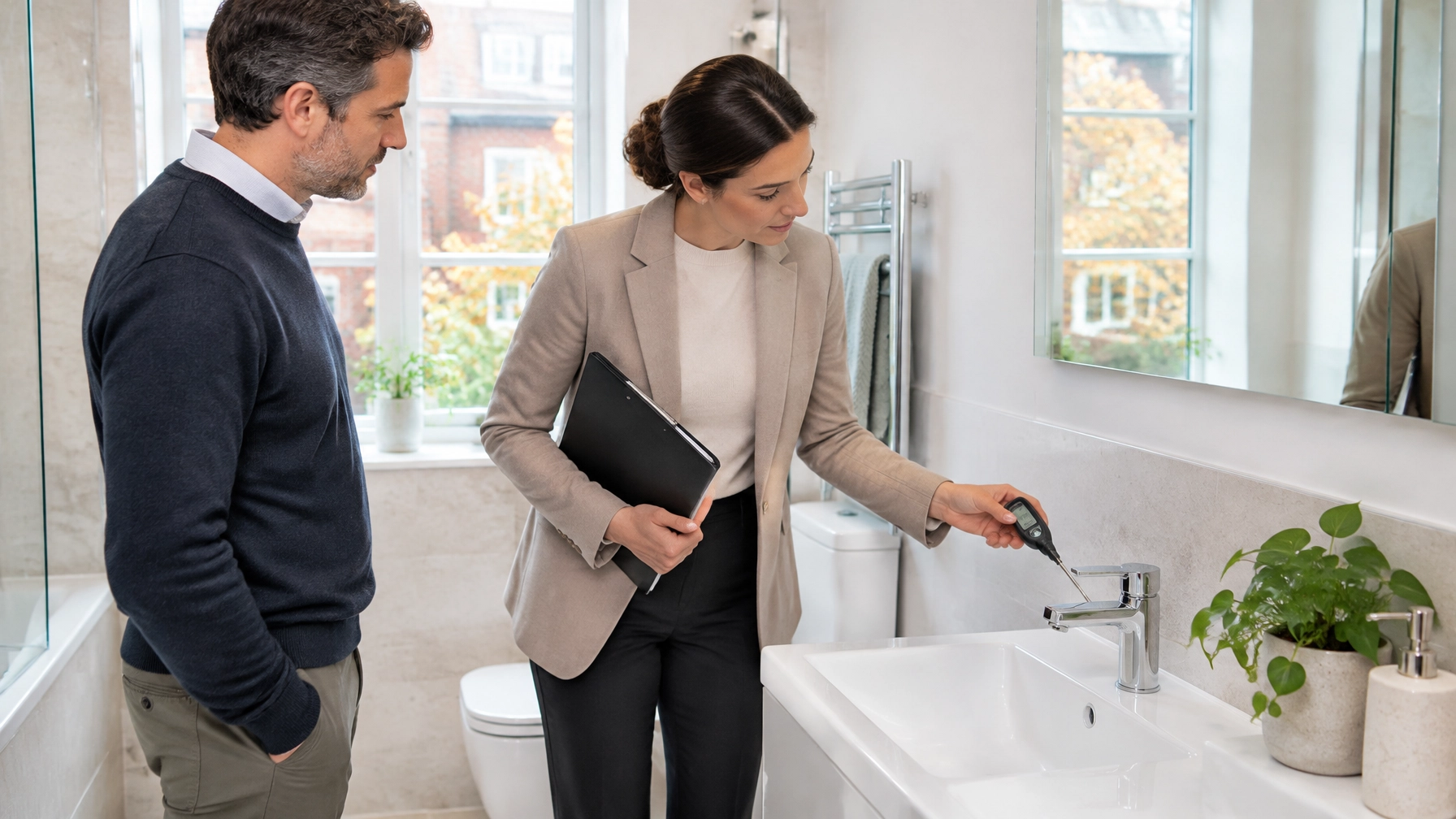
If you have booked a Legionella risk assessment, you may be wondering what the assessor actually does once they arrive. Do they take water samples? Inspect every tap? Produce a certificate with a large red “PASS” stamped across it?
Usually, it is more practical than that. The assessor looks at how water moves through the property, where it could stagnate, and whether existing controls are suitable. The visit is also a useful chance to identify issues that can be easy to miss between tenancies.
That matters in autumn and winter. Empty properties, holiday lets and little-used bathrooms may see less water movement as the weather turns colder and routines change. Stagnation is not an automatic cause for alarm, but it is a reason to understand your system and manage it properly.
Before the visit: what should you prepare?
Make sure the assessor can access the relevant parts of the property. That may include bathrooms, kitchens, utility rooms, airing cupboards, water tanks and the boiler or hot-water cylinder. If a cupboard is packed with spare paint tins, now is a good time to liberate the pipework.
It also helps to share useful background: how long the property has been vacant, whether any outlets are rarely used, what type of hot-water system is installed, and whether there have been plumbing alterations or recurring problems.
For a property between tenancies, tell the assessor when it was last occupied and whether anyone has used the taps or showers since. A little context can make the assessment more accurate and help the assessor focus on the right risks.
Step 1: the assessor establishes how the water system works
The visit usually begins with a walk-through. The assessor identifies how cold water enters and is stored, how hot water is produced, and how water reaches outlets around the property.
They may look for a combi boiler or hot-water cylinder, a cold-water storage tank, showers, outside taps and thermostatic mixing valves. They also consider the pipework connecting them. If the layout is not obvious, they may trace the system and record its key features, sometimes in a schematic.
The aim is not simply to count taps. It is to understand the system as a whole, including sections of pipe that may hold water without regular use.

Step 2: they check for stagnation and other risk factors
Next, the assessor looks for conditions that could make the system harder to manage. These may include long or redundant pipe sections, outlets that are seldom used, sediment or scale, leaks, damaged insulation, or water tanks and pipework exposed to unwanted heat.
Low-use outlets deserve particular attention in autumn and winter. A spare bathroom that sees little action, an outside tap, or a shower in a vacant flat may not get the regular water movement it needs. Holiday lets and properties between tenants can have similar patterns, especially after several quiet weeks.
The assessor may also ask who uses the property and whether anyone may be more vulnerable to Legionella. This helps put the physical findings into context. Risk depends on the system and how it is used, not simply on the property’s age or postcode.
Step 3: they inspect outlets and take readings
The assessor will usually check relevant taps and showers, and may take temperature readings at selected outlets or parts of the system. These readings help show whether water is being stored and delivered in a way that supports effective control.
They may look at shower heads and hoses for scale or deposits, as well as the general condition of fittings. A shower is worth checking because it can create fine water droplets, so it should be maintained in line with the assessor’s recommendations.
A routine assessment does not automatically involve laboratory testing. Water samples may be recommended in some circumstances, but the assessor should explain why they are needed rather than treating sampling as an automatic part of every visit.

Step 4: they review how the property is managed
A sound assessment considers more than pipes and fittings. The assessor may ask who is responsible for maintenance, how often little-used outlets are checked, and what happens when the property stands empty.
This is where autumn preparation can be useful. If a flat has been vacant over summer or a holiday let has had a quiet period, ask what should happen before the next occupation. Follow the assessor’s system-specific advice for flushing, cleaning or other controls; there is no single routine that suits every installation.
Do not assume a quick run of every tap is a complete solution. The right actions depend on the system, its condition and the assessor’s findings. Clear instructions are more useful than guesswork. Particularly when several people manage the property.
How long does a Legionella assessment take?
For a typical house or flat, a visit may take around 20 minutes to an hour. Treat that as a guide, not a guarantee. A straightforward property with a simple system may be quicker, while a larger home, multiple bathrooms, a storage tank, access issues or more complex pipework can take longer.
If the assessor needs to investigate a concern or cannot access part of the system, the visit may also take more time. Ask what areas need to be available and whether the quoted appointment includes time to discuss the findings.
What should the report contain?
The written report should make the assessment understandable and useful. Look for:
- The property details, assessment date, scope and any areas the assessor could not access.
- A description of the hot- and cold-water systems, including relevant tanks, cylinders, outlets and pipework.
- The hazards identified and an explanation of how they affect risk at the property.
- Relevant readings and observations, linked to the parts of the system they relate to.
- Existing control measures and whether they appear adequate.
- Clear recommendations, including what needs attention and how urgently.
- Any suggested monitoring, maintenance, review or further investigation.
Be cautious if the report offers only a generic “pass” without describing the system or explaining what was checked. A useful report records the property’s actual circumstances, including limitations. Keep it with records of maintenance and any remedial work so the information is easy to find when a property changes hands or tenants.

After the visit: act on the findings
Read the recommendations and make a plan. That could mean repairing a leak, improving insulation, addressing a redundant pipe section, cleaning a shower fitting, or setting up a suitable routine for low-use outlets. If the report identifies a higher-priority action, deal with it promptly and keep evidence of the work.
There is no need to book an assessment just because autumn has arrived. The important point is to review risk when the property or water system changes, when periods of vacancy affect use, or when you have reason to think the existing assessment is no longer suitable. Before a long-unoccupied property is reoccupied, check that the system has been managed appropriately.
Make the paperwork useful, not just filed
A Legionella risk assessment is about understanding and controlling risk, not collecting another document for a folder that nobody opens. A clear report helps you decide what to do, who will do it and how you will keep the system under review.
For tenancy records, keep water-system information alongside other property documentation, but make sure the distinction is clear: a property inventory records the condition and contents of a home; it is not a Legionella risk assessment.
Evestaff Property Inventory Clerks has supported property professionals since 2012, with experienced clerks working across London and Kent. As accredited members of ECMK, we focus on meticulous, precision-led inventory documentation, supported by modern technology. That expertise helps you create a reliable record of property condition, while water-system risks should be assessed by a competent Legionella professional.
If you are arranging a first booking, our Refer a Friend offer is worth a look: new customers receive 10% off their first booking. A neat report, a well-managed water system and a tenancy file you can actually navigate? Autumn admin can have its small victories.
Join The Discussion