

"Kitchen table – fair condition." "Carpet – worn in places." "Bathroom – clean."
If these descriptions look familiar from your property inventory reports, you're sitting on a time bomb. In 2026's tougher adjudication landscape, generic descriptions like these won't just fail to protect your clients' deposits: they'll actively work against you when disputes land at the ombudsman's desk.
The reality? Vague inventory descriptions are costing letting agents and property managers thousands in unwinnable deposit claims. And as regulatory scrutiny intensifies, the gap between "average" documentation and what actually stands up in adjudication is widening fast.
The Real Cost of Generic Descriptions
When a tenant challenges a deduction for a "damaged kitchen table," what does "fair condition" actually mean? Was the surface scratched? Were the legs wobbly? Was the finish worn? Without precise baseline documentation, you're asking an adjudicator to take your word over photographic evidence that a tenant can easily produce showing the table "wasn't that bad."
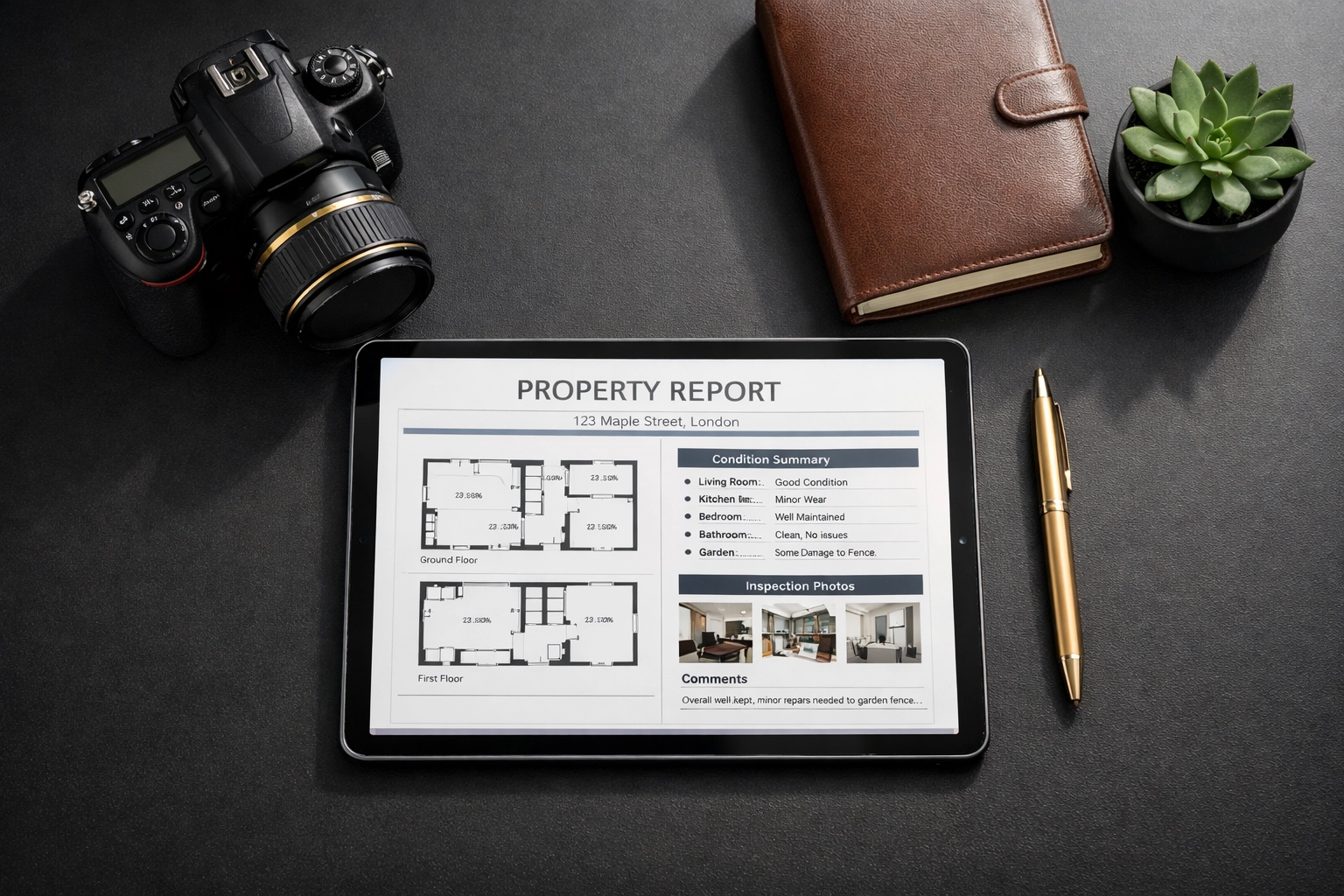
Property managers across London and Kent are learning this lesson the hard way. We've seen cases where landlords lost £800 carpet replacement claims because the check-in report simply noted "beige carpet – good condition." The tenant's defence? "It was already stained when we moved in." Without detailed documentation of the carpet's exact condition: including specific stain locations, wear patterns, and pile depth: the adjudicator had no choice but to rule in the tenant's favour.
The financial impact adds up quickly. Lose three deposit disputes at £500-£1,000 each, and you've wiped out a significant chunk of your annual management fee revenue. More importantly, you've damaged client relationships and your reputation as a professional letting agent.
What 2026 Standards Actually Require
The adjudication bodies haven't published new "2026 standards" in an official document. Instead, what's changing is the expectation level based on available technology and evolving case law. Adjudicators increasingly expect inventory reports to meet these criteria:
Itemised specificity: Every item must be described with enough detail to establish its exact condition. "Sofa" becomes "three-seater fabric sofa in grey tweed, showing minor pilling on left armrest, small coffee stain (2cm diameter) on right cushion, all cushions present and structurally sound."
Photographic cross-referencing: Descriptions must reference corresponding high-resolution photographs. The description alone isn't enough: it needs to point to visual evidence that supports every claim.
Measurement and quantification: Where possible, include measurements. "Scratch on worktop" becomes "15cm horizontal scratch on kitchen worktop, 2cm from sink edge, penetrating laminate surface to substrate level."
Condition grading consistency: Use a standardised condition scale throughout the report. Whether you use "Excellent/Good/Fair/Poor" or a numbered system, apply it consistently across all items.
The Difference Between Average and Audit-Ready Descriptions
Let's compare two approaches to documenting the same bathroom:
Average description:
"Bathroom – clean. White suite. Some limescale on taps. Shower curtain present. Tiles in good condition."
Audit-ready description:
"Bathroom – White ceramic suite comprising pedestal washbasin, close-coupled WC, and bath with overhead shower. Limescale deposits present on chrome bath taps (particularly around base and spout). White fabric shower curtain installed, showing minor mildew staining along bottom edge (see Photo 47). White ceramic wall tiles throughout in good condition with intact grouting. Chrome heated towel rail operational. Extractor fan operational. Vinyl flooring in good condition with no lifting or damage (see Photos 48-51)."

Notice the difference? The audit-ready version establishes a precise baseline that makes it nearly impossible for tenants to claim pre-existing damage wasn't documented. More importantly, it gives you defendable evidence when legitimate damage occurs during the tenancy.
High-Definition Evidence: Why Photo Quality Matters
Here's something most letting agents miss: the quality of your inventory photographs matters as much as the descriptions themselves. In 2026, submitting grainy mobile phone photos that were acceptable five years ago won't cut it anymore.
Modern inventory reports should include:
- High-resolution images (minimum 12MP) with proper lighting
- Multiple angles of each room and key items
- Close-up detail shots of existing damage or wear
- Timestamp and geolocation metadata preserved
- Consistent photography protocols across all properties
At Evestaff, we've invested in professional photography equipment and training for precisely this reason. Our clerks understand that a well-lit, sharp photograph of a carpet stain provides irrefutable evidence that protects both landlord and tenant interests.
The technology exists: there's simply no excuse for poor-quality documentation anymore. Adjudicators know this, which is why they're less sympathetic to claims supported by inadequate photographic evidence.
Grouped Categories vs. Individual Items
One common question we hear: "Do I really need to itemise every single book, DVD, or kitchen utensil?"
The answer depends on value and replaceability. For furnished properties, you need to strike a balance between excessive detail and useful documentation.
Items requiring individual documentation:
- Furniture pieces
- Appliances (including serial numbers where accessible)
- Artwork and decorative items
- Floor coverings and window treatments
- Fixtures and fittings
Items suitable for grouped documentation:
- Kitchen utensils (documented by category: "8 dinner plates, 8 side plates, 8 bowls – white ceramic Ikea range")
- Books or media collections (if left by landlord)
- Cleaning supplies
- Basic kitchenware
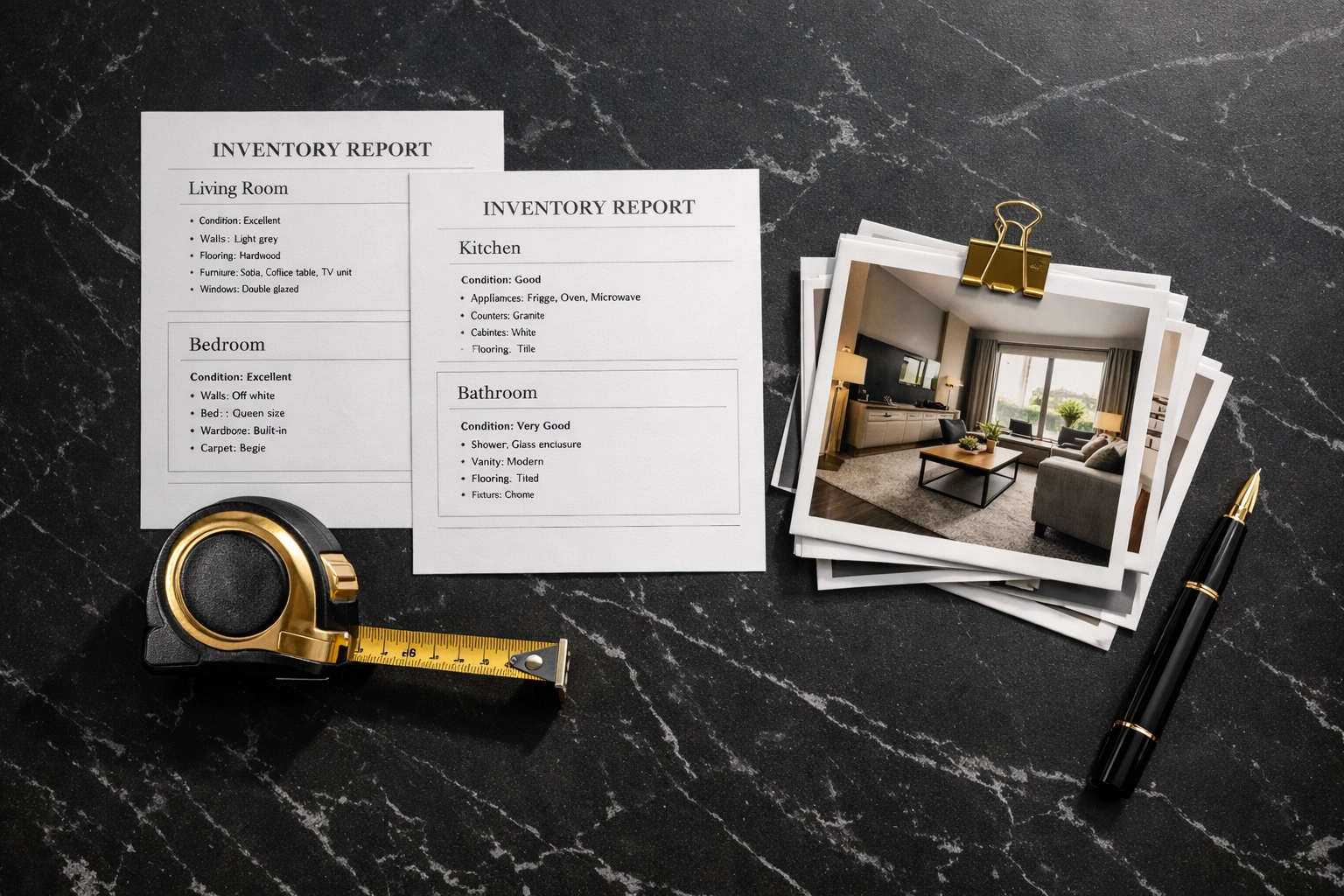
The key is ensuring that grouped categories still contain enough detail to verify quantities and condition. "Kitchen utensils – full set" fails the standard. "Complete 24-piece stainless steel cutlery set (8 x knives, forks, spoons), John Lewis brand, good condition with minor scratching consistent with normal use" passes it.
Condition Grading: Creating Your Baseline
One of the biggest failures in property inventory reports is inconsistent condition grading. If you describe one room's carpet as "fair" and another as "good," what's the actual difference? Without clear definitions, these terms become meaningless in disputes.
Establish a grading system and apply it consistently:
Excellent: New or nearly new condition with no visible wear, damage, or defects. Suitable for premium properties or recently renovated items.
Good: Shows light wear consistent with normal use but remains in fully functional condition with no repairs needed. This is your baseline for most well-maintained rental properties.
Fair: Visible wear, minor damage, or defects present but item remains functional. May require minor repairs or attention during tenancy.
Poor: Significant damage, heavy wear, or functional issues present. Item may require replacement or major repair during or after tenancy.
Document specific reasons for each grading. "Carpet – Fair condition" tells you nothing. "Carpet – Fair condition due to visible traffic patterns in doorway area, small stain (10cm) near window, and minor fraying along skirting edge in northeast corner" gives you something to work with.
The London and Kent Advantage
If you're managing properties in London or Kent, you're operating in one of the UK's most competitive and regulated rental markets. Tenants here are increasingly savvy about their rights, and deposit disputes are more common than in other regions.
This makes professional inventory standards even more critical. A proper check-in report doesn't just protect deposits: it establishes professional credibility with both landlords and tenants from day one.
We've been conducting property inventories across London and Kent since 2012, and we've seen firsthand how the quality threshold has evolved. What passed for adequate documentation a decade ago now falls well short of what adjudicators expect.
Technology as Your Quality Multiplier
Modern inventory technology has transformed what's possible in property documentation. Cloud-based inventory software allows clerks to:
- Capture and organise hundreds of photographs efficiently
- Apply consistent templating and condition grading
- Generate comprehensive reports in branded formats
- Provide secure online access for all parties
- Maintain detailed audit trails of all documentation

But here's the critical point: technology amplifies quality: it doesn't create it. A poorly trained clerk with expensive software still produces substandard inventories. The combination of experienced personnel and modern technology is what delivers audit-ready documentation.
Our clerks combine decades of collective experience with purpose-built inventory platforms that ensure nothing gets missed and everything gets documented to 2026 standards.
Implementation: Making the Switch
If you're currently working with inventory providers who deliver average descriptions, making the switch to audit-ready documentation requires some planning:
Review your existing reports: Pull recent inventories and honestly assess whether they'd withstand scrutiny in a dispute. Look for vague descriptions, poor photography, and inconsistent grading.
Set clear expectations: When commissioning inventory work, specify that you require detailed itemisation, high-resolution photography, and consistent condition grading throughout.
Budget appropriately: Quality documentation takes more time than generic reports. If your current provider charges significantly less than market rate, question whether you're getting audit-ready quality.
Train your team: Ensure property managers understand what constitutes good inventory documentation so they can properly review reports before they're finalised.
Implement quality checks: Build a review process that catches inadequate descriptions before reports reach landlords and tenants.
The Bottom Line
Generic inventory descriptions aren't just inadequate: they're actively risky in 2026's adjudication environment. Every vague description is a potential lost deposit claim. Every poor-quality photograph is ammunition for a tenant defence.
The good news? Making the switch to detailed, audit-ready itemisation isn't complicated: it just requires working with inventory professionals who understand current standards and invest in proper documentation.
Your reputation as a letting agent or property manager depends on getting the details right. In an industry where trust and professionalism separate the best from the rest, your inventory documentation speaks volumes about your standards.
If you're managing properties in London or Kent and want to ensure your inventory reports meet 2026 standards, get in touch with our team. We've been perfecting property documentation for over a decade, and we'd be happy to show you what audit-ready quality actually looks like.
Join The Discussion